
Code Enforcement in any municipality serves a very specific function. And, theoretically, they have influence and input over every stage of a homeowner’s efforts doing work on a home.
During the building process, code enforcement ensures adherence to the Florida Building Code as well as the comprehensive plans. Additionally, if there are any specific requirements established during the approval process, especially if there is an ordinance specific to the approval, they are responsible for ensuring those requirements are met.
Whether it’s during a documented building process or a homeowner doing work on their property, Code Enforcement also is responsible for things making sure the work being done is properly permitted.
At all times, they are responsible for things like making sure wetlands are not filled, unless a permit is given to mitigate the wetland. This means that a homeowner or developer receives permission to fill a wetland and pay money to basically buy to support a wetland in another part of the state.
Martin County states on the Code Enforcement page, “The objective of the Martin County Code Enforcement Division is to educate and gain voluntarily compliance of all county code ordinances. Keeping Martin County compliant protects and enhances property values and makes the county a more attractive place to live.”
In fact, the County has a 2-page document that identifies common code enforcement violations. Some examples include:
- Grass and weeds shall not be more than 18” tall
- Trash shall not be excessively accumulated
- Fences and garages shall be maintained
- Pools shall be clean and maintained
There are obviously others, but this is the guide provided to residents for common occurrences for awareness for homeowners.
The City of Stuart’s Code Enforcement page discusses the “Importance of Code Compliance.”
It reads, “Times change and so do the attitudes and lifestyles of the community. It is a known fact that the more citizens a society serves, the greater the need for codes and procedures to address the everyday problems of a community building and growing.
Often we recognize the need for such codes only after we have reached a critical stage and it is too late. There was not much urgency about building codes until the devastating aftermath of Hurricane Andrew. Then the need for more stringent code was apparent.”

In both municipalities, there is supposed to be a process by which violations are reported to the respective County or City and, in both cases, there is inconsistency in how violations are received and addressed.
The Code Enforcement Dilemma
When researching this subject, it became abundantly clear that there are too many examples to list.
But the process, in its simplest form is this:
- The reports are received.
- Code Enforcement typically goes out to the site to review the complaint filed.
- Code Enforcement documents the situation. They speak with the homeowner, if available, take photos, and draft a report.
- The report is provided their supervisors.
- Sometimes the homeowner is given a chance to remedy the situation, assuming it’s something minor.
- If the violation is egregious, the item will be scheduled with the Magistrate to review the violation.
- The Magistrate will hear the case with the City or County presenting as a prosecutor would. The homeowner, often representing themselves with no counsel, will provide a response.
- The Magistrate will issue a fine and conditions, such as a date a permit is to be obtained and the parameters of the work that is allowed.
- The homeowner will sign a document agreeing to the conditions.
The system works… if all parties are playing by the same rules.
The flaws in the process
There are multiple emails and notes in the respective Code Enforcement systems that clearly demonstrate that the process is flawed.
Sometimes the property owner is doing this work without a permit and, therefore, without any guidance. Sometimes the owner does it because a permit is expensive. Some property owners have stated it’s their property and they have rights. And some property owners are fully aware of the violations and know there is nothing that can or will be done.
Code Enforcement is tasked with receiving reports, almost always from concerned neighbors, and investigating them. There have been multiple instances of photographs and videos being submitted as part of the reports.
For example, there have been instances where a property owner has been caught on camera performing work without a permit or work that is not allowed.
These photos are integral to documentation of the violation and are necessary.
Ultimately, there are multiple documented cases where ample documentation is provided, a case is made, a fine is issued, and the County or City response to the homeowner’s efforts are contingent upon the homeowner or developer’s relationship with the municipality and those in charge.
How the City and County respectively respond to a homeowner or developer specific to the actual enforcement and requirements of the documented violations is seemingly contingent upon a number of factors including politics, but mostly it’s contingent upon how the County or City Attorney feels about you.
There is no better examples of this in the City of Stuart than the case of 228 SE Ila Street.
It helps if the City Attorney likes you…
On March 19, 2025, the City of Stuart presented to the Code Enforcement Magistrate, Paul Nicoletti, its case against Robert Haas.
Mr. Haas, whose property at 228 SE Ila Street, had been converted from a recorded single-family residence to basically a triplex to allow Mr. Haas to rent out two of the units as an Airbnb.
The violation was well documented by Mr. Haas’s former tenant who provided a myriad of photographic evidence to Code Enforcement and the City of Stuart’s then attorney, Michael Mortell.
Mr. Mortell, in copious email communications to the Mr. Haas, his former high school classmate, states that he was providing an opportunity for Mr. Haas to not pay any fines. He basically ran interference for Mr. Haas because of their relationship. He states “I went to bat for you because I knew you and your family since Highschool.”

He then goes on to later say “… Bob Haas claims he doesn’t have to do anything because he knows Mike Mortell and David Dyess and they will let him do what ever he wants and there will not be a fine.” I don’t know who you said that to or why but you need to know that I have done everything I can. I went out on a limb and got the consent agree that would waive everything if you complied by Oct 31. When you blew that off and did not do anything except for continue to do even more work without a permit, you put me in a really bad spot. If I get fired over this case, I am sure the next lawyer the City hires is going to be much harsher than I would ever be.”

Also in this email there is a statement that there would be NO FINES OR PENALTIES for at least some of the work done.
On 12/21/2022 Mr. Mortell wrote “If you read the agreement, you will see that it says if you obtained the after the fact permit by October 31, you did not have any penalty at all. ZERO, nothing. That was a great deal. This is not a situation where someone replaced the hot water heater and didn’t realize they didn’t need a permit. This was a complete and total remodel. By your own emails you claim that it was every single room in your house.”

Fast forward to March 19, 2025, when the situation became egregious enough to be heard in front of the Magistrate.
Mr. Nicoletti stated he was giving Mr. Haas until 4/19/2025 to obtain his permits and until 5/19/2025 to complete the cleanup of the yard.
The Magistrate stated and Mr. Haas agreed that if these things were not done, the fine to be assessed would be $100 per violation per day and Mr. Haas would be required to pay $300 in costs to the City.
Today on Ila Street
Mr. Bomeisler, the former tenant on Ila Street, has continued to document the conditions on Ila Street.
He has been diligent about emailing Mr. Mortell, who is now City Manager, Lee Baggett, the recently hired City Attorney, and the Commissioners.
On June 11, 2025, Mr. Bomeisler sent an email discussing the lack of oversight by the City as it relates to the property on Ila Street and included a picture confirming the lack of effort by the homeowner to clean up his yard.
Part of the email reads, “Almost three months have passed since the magistrate meeting which addressed this property owner’s code violations relating to illegal multi-family conversion and side yard debris. As the attached side yard photo taken on June 10, 2025 clearly illustrates, daily fines are not a deterrent for this individual and will not result in compliance. The City bears responsibility for enforcing its codes as well as mitigating potential health and safety risks associated with code violations that have been repeatedly reported. Perhaps it’s time to develop an escalation plan, rather than simply allowing the toothless $100/day fine to keep running perpetually.”

Mr. Mortell responded with a lengthy email acknowledging the “disregard for personal property left to decay in the back yard as well as the lack of concern for the impact on his neighbors.”
The next sentence reads, “But, the condition can not (sic) be observed from the public right of way and there have been no complaints regarding the condition of the property. If you contact the Code Enforcement office and make a complaint in accordance with Florida Statute, Section 162, then I am confident that a Code Officer will go to the site and investigate. If a violation is found, then a citation will be issued.”
On Thursday, June 12, 2025, Mr. Bomeisler responded asking point blank what the City’s next step would be to bring the property in to compliance.

Not relying on Mr. Mortell’s addressing on the situation, Mr. Bomeisler also emailed Robert Perez, Code Enforcement Officer for the City of Stuart.

Mr. Baggett is reported to have stated to at least one commissioner that the only thing that can be done is the fines can accrue.
So what happens to the fines?
The fines accrue until they don’t. There is no simpler way to say it.
To demonstrate how fruitless the fines are we need look no further than the example of 820 14th Street.
In 2019, the homeowner initiated installing a new roof without a permit.
It was documented by Code Enforcement in their system.

On May 15, 2020, Code Enforcement Building Official, Steve Nicolosi, wrote “If you get a call from the owner it’s OK for him to sign a stipulation order. I talked to a contractor who is going to pull the permit. We will give him 30 days to permit.”

The homeowner and City signed the Stipulation and Agreed Order on May 19, 2020. On May 22, 2020, the Magistrate, Thomas J. Baird, signed the order, which included the daily fines to be applied until the property was brought into compliance. This also included assigning a lien to the property which was recorded on the Martin County Clerk’s site.
Fast forward to 2023…
The fines for the property at 820 14th Street accrued to $62,750.
The homeowner called and left a message to discuss the reduction in fines so he could finish his roof.
On February 3, 2023, there is note in the Code Enforcement system.
“Mike Mortell City Attorney has negotiated the fine amount to $2500.00. A payment has been received by the property owner.”

The lien was released on February 10, 2023.
It is unclear the relationship between Mr. Mortell and homeowner, if any.
Some municipalities, like Casselberry and Fort Myers, have specific ordinances or municipal code that clearly state the parameters of what a City Attorney or Manager can do when it comes to reducing or waiving fines.
When I asked the City for the justification of the City Attorney negotiating with a resident to reduce fines so drastically, I was provided with municipal code.
Sec. 26-23. – Duties of city attorney.
The city attorney shall represent the city, and may present testimony and evidence through any competent witness, including but not limited to police officers, civilian parking enforcement officers, enforcement officers, and other city employees, or persons. The city attorney may attend all code compliance hearings, and may present and prosecute any or all cases to come before a magistrate. The city attorney shall also be responsible to see to the foreclosure of all code compliance liens, and compliance with all magistrate orders.
This municipal code is extremely vague. There are no defined parameters for the reductions allowed, just that it’s at the discretion of the City Attorney.
And the homeowner of 820 14th Street seemingly benefited from the externally arbitrary discretion used by the City Attorney. But reviewing other examples, it’s clear that the percentages and dollar amounts negotiated are not consistent nor are they equitable.
So now what?
With Mr. Baggett seemingly stating that the fines for the property on Ila Street will just continue to accrue but there being no plan for the City to enforce the codes nor to collect the fines, what is the point of having fines?
It is seemingly not uncommon for municipalities to reduce code enforcement fines after compliance is reached.
The goal is to bring properties into compliance. That makes sense.
But the way a fine is assessed or enforced is at the discretion of those in charge does not make sense.
Yes, there will always be extenuating circumstances, and no situation is identical.
However, the preferential treatment given to some homeowners and developers who have the financial and logistical wherewithal to do it right but choose not to are part of the problem.
The other part of the problem is the selective application of assistance – whether it’s the helping of finding a contractor to pull a permit or the waiving of fines – and the disparate treatment not provided to all.
On February 1, 2017, Mr. Mortell emailed Caryn Hall that fines need to determined in a hearing with the Magistrate but that won’t be “until such time as someone is going ot settle the debt.”

The Caryn Hall case is unique with its own circumstances and legal issues. In none of the email correspondences reviewed, did Mr. Mortell agree to decrease any fines. In fact, in an email dated September 11, 2022, he actually states that if she wants to sell her property, any request for any fine reductions that only the City Commission can waive the lien.
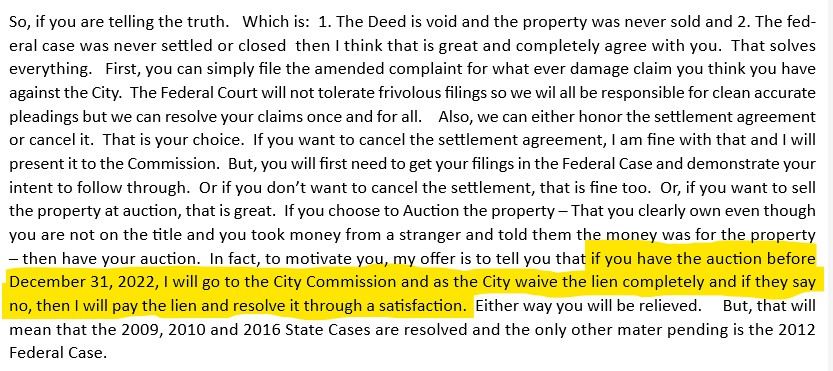
What we need to know is has anyone else been told by the City Attorney that he doesn’t have that authority? Or is his authority contingent upon how he feels about the person or developer asking?
There needs to be an audit of the reasons the fines are waived or never assessed to determine if there should be a revision to how code enforcement operates. There need to be rules BUT the rules need to be applicable to everyone and they need to be APPLIED to everyone.
Additionally, the discretion with which one person can have to determine what the rules are and to whom the rules are applied needs to be reviewed and better defined.
The rules applied to one need to be applied to all.